The whole pipeline, what it cost, and the paper
The food bank twin end to end, from video to world model to Blender to AWS to Omniverse, with the full cost picture, what is real versus simulated, what failed, and the paper that documents it.
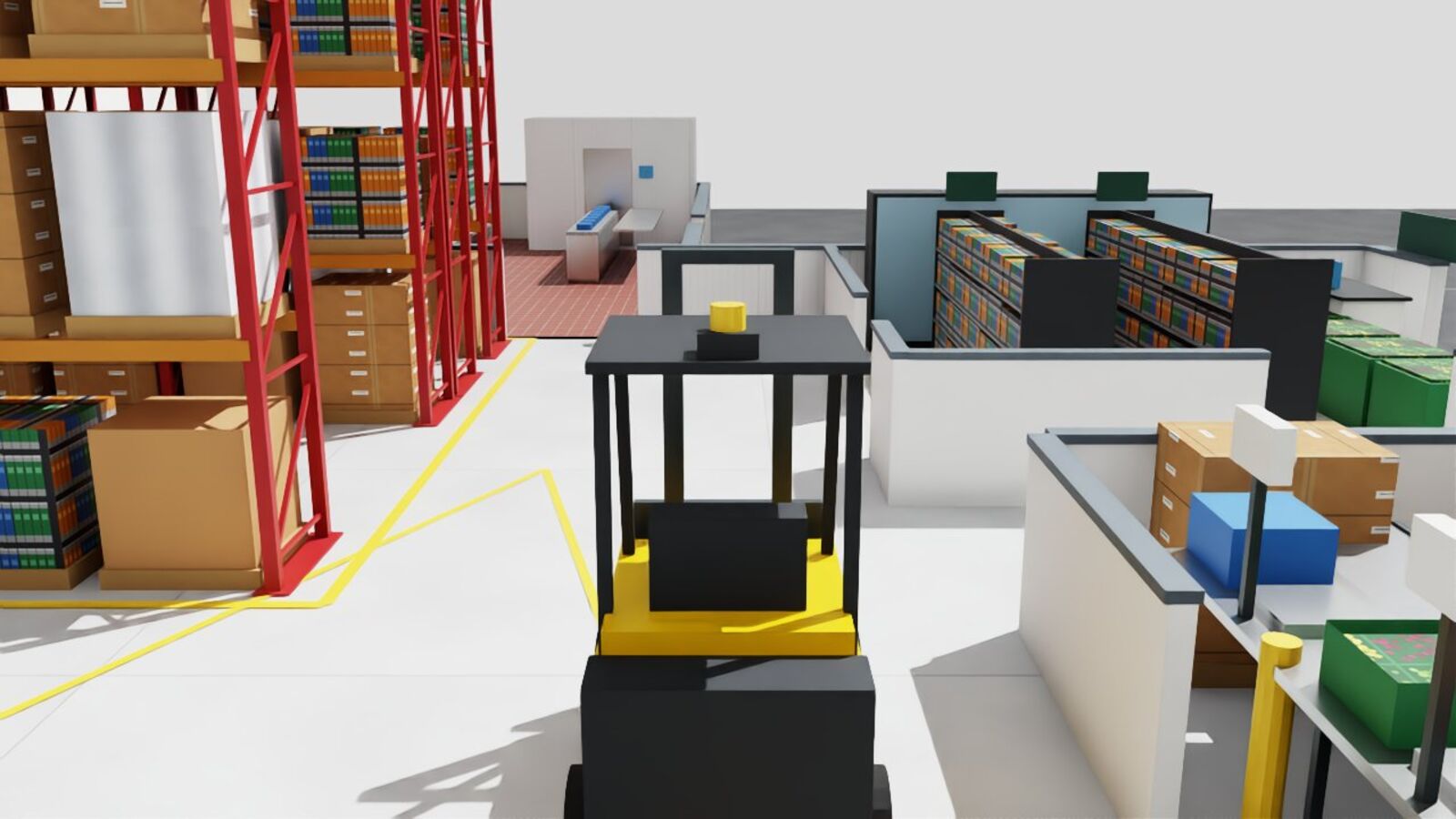
Four parts, four layers. This one puts them together, adds up the cost, and points to the paper that writes it all down properly.
The pipeline on one page
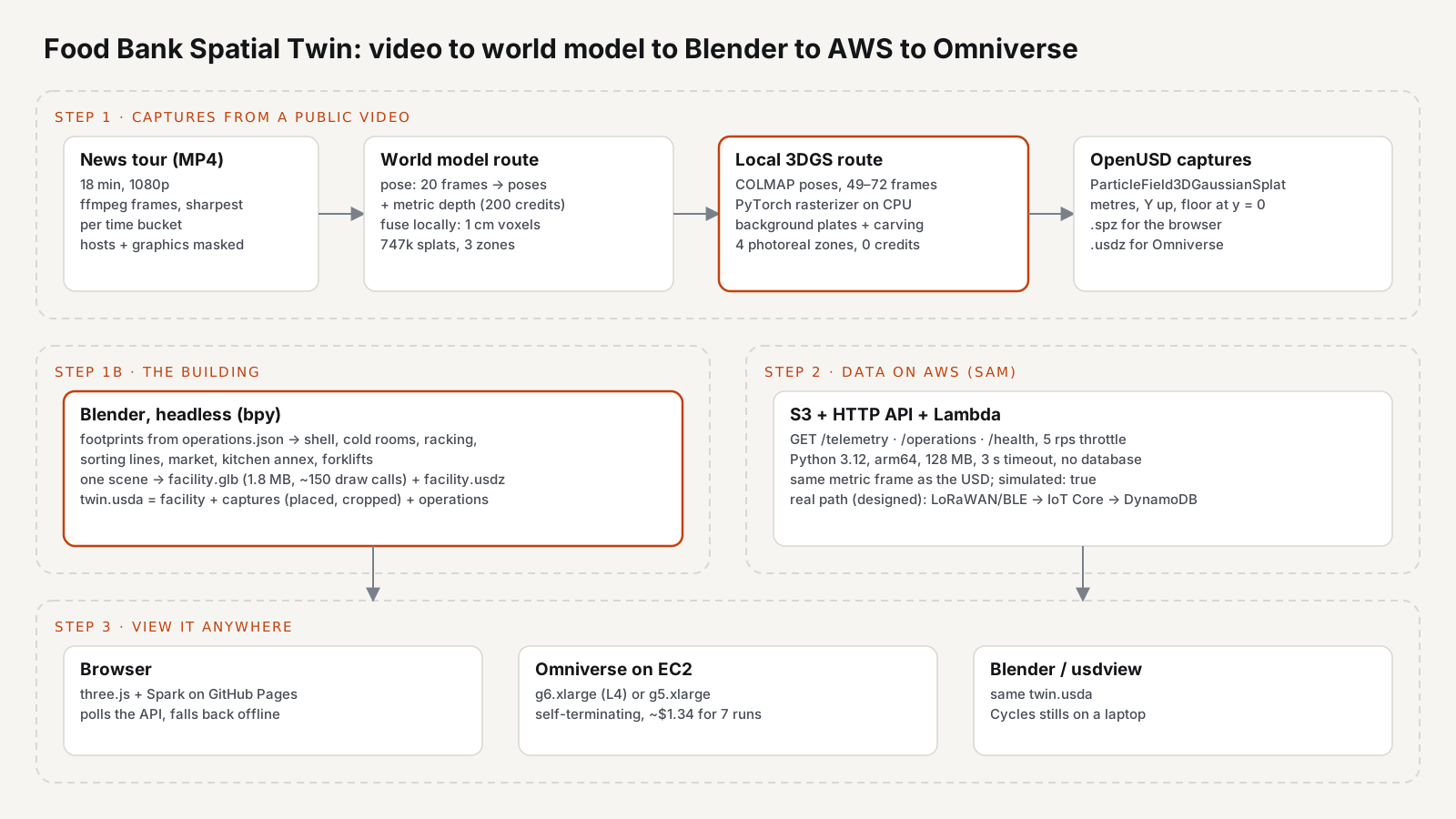
video (MP4)
  -> frames, people masked                       ffmpeg, MediaPipe
  -> world model: poses + metric depth           20 frames, 200 credits
  -> fused splats, and locally trained 3DGS      COLMAP + PyTorch, 0 credits
  -> OpenUSD captures (metres, Y up, floor at 0)

operations data
  -> Blender, headless                           one script
  -> facility.glb (browser) + facility.usdz (Omniverse)

twin.usda = facility + captures + operations, one frame

AWS: S3 + HTTP API + Lambda                      /telemetry, /operations
  -> browser on GitHub Pages | Omniverse on EC2 | Blender
OpenUSD is the only interface between the steps. That is what makes the renderer a deployment choice: the browser for anyone with a link, Omniverse when you need RTX and simulation, Blender on a laptop.
What it cost
| Cost | |
|---|---|
| This build: world model, local training, Blender, AWS, GPU trials | about $1.54 |
| Capture to deployed twin for a full facility of about 135,000 sq ft | about $25 to $50 of cloud spend |
| Real sensors on the floor | about $2,700 once, about $12 a month |
| Omniverse on demand, 10 hours a week | about $124 a month |
These are directional, from public list prices and one individual AWS account. Enterprise discounts, quotas and policies will differ.
What is real, and what is not
| Part | Kind |
|---|---|
| Racking aisle, sorting room, client market, community kitchen | Captured from the video, partial |
| Absolute scale | Estimated from the world model's metric depth |
| Building shell, cold rooms, staging, kitchen annex | Designed |
| Volumes, capacities, recipes, step times | Published figures or flagged estimates |
| Temperatures, doors, forklifts, inventory | Simulated, and every payload says so |
What failed
Generating views of unfilmed space failed twice on the provider's side. Omniverse loaded the splat captures and drew them blank. Both are listed in the repo with what I tried. Filling in unseen space is the open step, and it is the one I expect the next round of world models to close.
The paper
The build is written up as a paper: From Video to Digital Twin: Accelerating Spatial Twins with World Models and NVIDIA Omniverse. It covers the method, the provenance labels, the measurements, and the limits, with three supplementary movies. Read the PDF, or browse the LaTeX source and figures in the repository's paper/ folder.
What I would tell someone starting one
- Start from footage you already have. It is enough to get a first twin and to find out which parts are worth real money.
- Pick the contract first. Metres, Y up, floor at zero, one scene format. Everything else becomes swappable.
- Label provenance from day one. It is what lets people trust the parts that are real.
- Make every paid step resumable and capped, and make cloud GPUs unable to outlive their job.
If you want the same approach applied to a very different operation, the Michelin Kitchen Twin series models The French Laundry's three-star kitchen the way a plant is modeled.